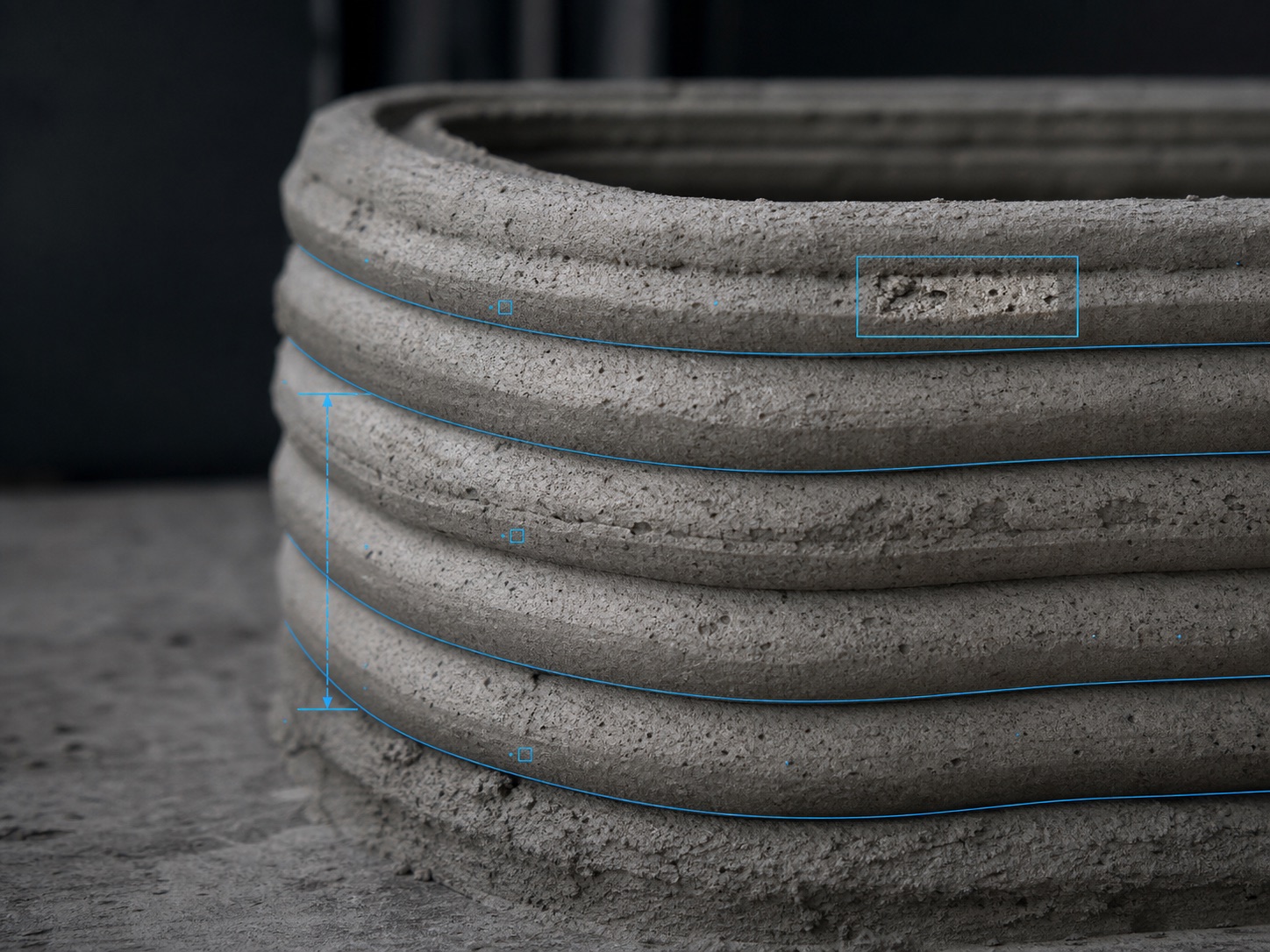
In extrusion-based construction 3D printing, the bead is the basic unit of the process. Every larger claim about geometry, strength, repeatability and scale depends on whether beads can be placed with predictable width, height, continuity and contact.
The bead shows whether parameters agree
A bead is created by the relationship between extrusion rate, travel speed, nozzle geometry, layer height and material rheology. If one variable moves out of range, the bead usually shows it before the whole print fails.
- A bead that is too narrow may indicate under-extrusion, high speed or poor flow.
- A bead that is too wide may indicate over-extrusion, low speed or slump.
- A changing bead height may indicate pressure variation, inconsistent feedstock or unstable motion.
- Gaps, tearing and surface roughness can point to material or nozzle issues.
Measurement turns defects into data
A visual defect is useful only if it can be described and compared. Computer vision can help measure bead width, layer position, continuity and surface irregularity, turning print observations into a feedback loop.
That does not mean every early-stage print needs a complex inspection stack. It means that the process should be designed so measurement can be added naturally as the system matures.
Bead control supports structural confidence
A printed wall is a stack of process decisions. If bead geometry is inconsistent, the layer stack inherits that uncertainty. Better bead control gives later testing a stronger foundation because the specimens and structures are produced from a documented process.
SRLK Tech treats bead geometry as a primary signal because it connects every part of the stack: material behaviour, extrusion, motion, software and sensing.